

Los Angeles, California (News4usOnline) — Over the years, we’ve seen Black and Brown protesters take to the streets time and time again, tracing back to the days of Dr. Martin Luther King Jr. and the Civil Rights Movement.
But there’s one thing many people still fail to notice—unless someone points it out. It’s the disparity in how Black and Brown protesters are treated by the police compared to predominantly white protesters.
This contrast was noticeable during the “Hands Off” protest, which was held on April 5 in downtown Los Angeles.
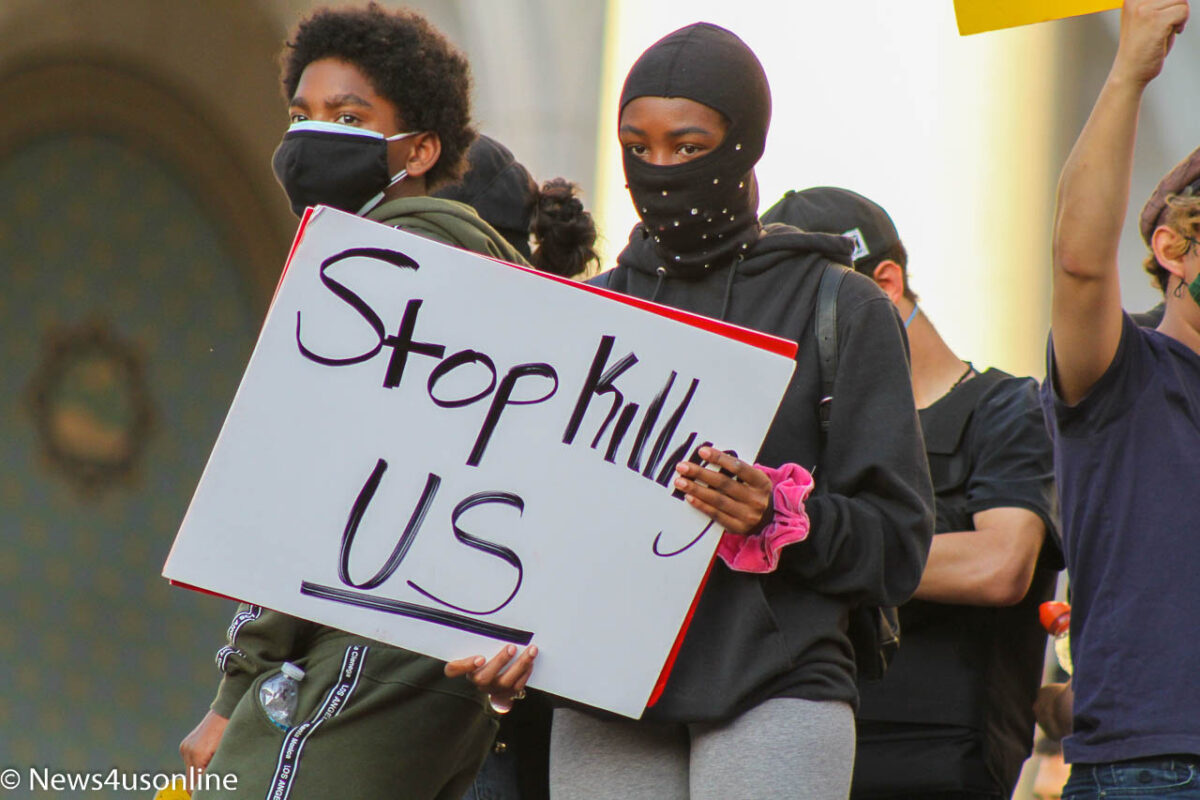
Statistics show a noticeable difference in how police respond depending on who is protesting and what they’re protesting for. Take the Black Lives Matter movement into account, especially in the aftermath of George Floyd’s murder in 2020.
Peaceful demonstrations were often met with heavily armed police in riot gear, tear gas, rubber bullets, kettling tactics, military-style equipment like armored vehicles and drones, and mass arrests.
According to a 2021 report by the Armed Conflict Location & Event Data Project (ACLED), over 93% of Black Lives Matter protests were peaceful. Despite this, law enforcement agencies were significantly more likely to intervene in racial justice demonstrations compared to other types of protests, such as anti-lockdown or pro-police rallies.
The report highlights a disturbing pattern of aggressive government responses, including the deployment of federal forces and extreme crowd-control measures.
In contrast, protests like the anti-lockdown demonstrations of 2020, the Capitol insurrection on January 6, 2021, and various pro-gun or far-right rallies were met with notably lighter police presence—even when participants were visibly armed or behaving aggressively.
In many cases, officers were seen interacting casually with protesters, taking photos, showing restraint, or failing to intervene in violent behavior.
Many factors contribute to this disparity such as racial bias within law enforcement culture, the perceived threat level tied to racial and political identity, the way the media frames protests as “riots” versus “freedom rallies,” and institutional power structures that influence who gets protected and who gets policed.
During the “Hands Off” protest, this difference was hard to ignore. With a predominantly white crowd, only a handful of police officers were present. The protest remained peaceful, and with little law enforcement interference.
That’s when the contrast becomes even more alarming—how Black and Brown communities are treated under similar circumstances, and how they are perceived as threats even during peaceful demonstrations.

According to Axios “Most participants were older and white, as seen at rallies across the country and confirmed to Axios — a stark contrast to the multiracial, Black-led protests launched in the wake of George Floyd’s murder.”
This demographic shift reveals the evolving dynamics of modern protest movements.
Traditional frontline activism by communities of color is increasingly being complemented by white allies stepping into visible roles, while many Black and Brown activists are exploring alternative strategies—through grassroots organizing, policy advocacy, economic pressure, and digital activism.
But as we watch protests like “Hands Off” gain attention and sympathy without the same kind of police escalation we’ve seen in the past, it forces us to ask: What is it that makes law enforcement show up differently? Who gets the benefit of the doubt? Who gets to be seen as peaceful before they even speak?
These are uncomfortable questions, but necessary ones. Because justice can’t be selective. Protest can’t be protected only when it’s convenient. And peace should never be policed by prejudice.
If we truly want to see change, then we have to be willing to examine not just what we protest—but how protests are received, and who gets to protest safely. Until that gap is closed, we’re only scratching the surface of what real equity looks like.
Featured Image: Three Black LAPD police officers take a knee in solidarity with demonstrators out in downtown Los Angeles, California, protesting the killing of George Floyd, on June 2, 2020. The march was led by the Baptist Ministers Conference. to protest police brutality and show solidarity behind a Black Lives Matter movement to hold police and law enforcement agencies more accountable. Demonstrators came out to also protest the death of George Floyd, a 46-year-old Minneapolis man who died in police custody on May 25, 2020. Photo credit: Dennis J. Freeman/News4usonline

Archangel Apolonio is a reporter for News4usOnline and a graduate of CSU Dominguez Hills, where she studied broadcast journalism. Her passion for writing stems from a deep understanding of how different communities are impacted, and she is driven by a desire to connect with people through meaningful storytelling. Email Archangel @ ArchangelPolonio@gmail.com.
Discover more from
Subscribe to get the latest posts sent to your email.